Energy.
Regional power generation, smart grids, clean energy, and energy sovereignty.
COMPREHENSIVE NATIONAL ENERGY POLICY FOR THE REPUBLIC OF GHANA
A Futuristic, Regionalised, Resilient and Integrated Energy Sector Framework
Featuring the Establishment of the Ghana National Power Consortium
1. Introduction
Energy is the lifeblood of every modern economy. No nation can industrialise, digitise, manufacture, educate, heal, secure itself, feed its people, create jobs, or compete globally without reliable, affordable, sustainable and intelligently managed energy.
For Ghana, energy must no longer be treated merely as electricity supply. It must be understood as a national security asset, an industrial development tool, a household dignity issue, a climate responsibility, a technological foundation, a revenue engine, and one of the most important pillars of the New Ghana Agenda.
Ghana has made significant progress in electricity access and power generation over the years, but the sector continues to face structural challenges. These include overdependence on centralised generation, transmission losses, distribution inefficiencies, financial instability, weak regional energy autonomy, high cost of power, limited renewable energy penetration, underutilised regional resources, ageing infrastructure, illegal connections, poor revenue collection, inadequate energy storage, and insufficient local manufacturing in the energy value chain.
A modern Ghana cannot continue to rely on an energy model where power is generated in limited national clusters and transmitted across long distances to regions with different resource potential, demand patterns and development priorities. The future requires a decentralised but coordinated national energy system where every region becomes an active power-generating zone, while still remaining connected to a national grid for power sharing, power trading, system stability and emergency support.
This policy therefore proposes a futuristic energy sector transformation built around the creation of the Ghana National Power Consortium, a national coordinating and investment body responsible for accelerating power generation, regional energy independence, renewable energy development, smart grid expansion, energy storage, regional power trading, research, innovation, financing, and private-sector participation.
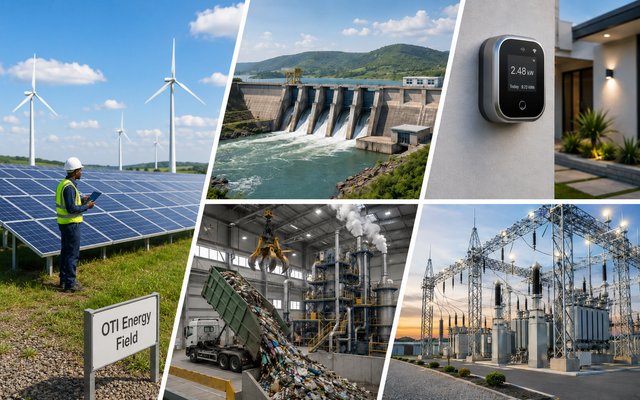
Under this policy, each region of Ghana shall be empowered to generate a significant portion of its own electricity through its natural resource advantage. Solar-rich regions shall develop large-scale solar parks. Coastal regions shall develop wind, wave, tidal and gas-related energy opportunities.
Agricultural regions shall develop biomass and waste-to-energy systems. River-based regions shall explore mini-hydro and floating solar. Industrial regions shall develop captive power, gas-to-power, battery storage, and smart grid systems. Urban regions shall deploy rooftop solar, waste-to-energy, district cooling, electric mobility charging systems and energy efficiency programmes.
The new energy philosophy shall be:
Every region must become a power-producing region.
This does not mean regions will operate in isolation. Rather, Ghana shall move from excessive central dependency to regional energy independence with national interdependence. Each region shall develop its own generation capacity, but all regions shall remain connected through a modernised national transmission and distribution architecture that allows power sharing, power purchase, emergency support, grid balancing and national reliability.
The Electricity Company of Ghana shall be retooled, modernised and transformed into a smart, commercially disciplined, technology-driven and regionally responsive distribution utility. ECG shall no longer operate as an overstretched centralised distribution institution. It shall be upgraded into a modern national distribution holding structure with strong regional operating companies, smart metering, digital billing, automated fault detection, prepaid systems, regional performance targets, energy theft control, customer service reforms and data-driven operations.
The future Ghanaian energy sector must be built on four pillars:
Generation decentralisation.
Grid modernisation.
Financial discipline.
Clean energy transition.
This policy seeks to create an energy system that is reliable enough to power industries, affordable enough to protect households, clean enough to protect the environment, intelligent enough to support the digital economy, and resilient enough to withstand climate, economic and security shocks.
Ghana must not only produce electricity. Ghana must produce energy sovereignty.