Local Government, Chieftancy and Religious Affairs.
Power closer to the people who live with the results.
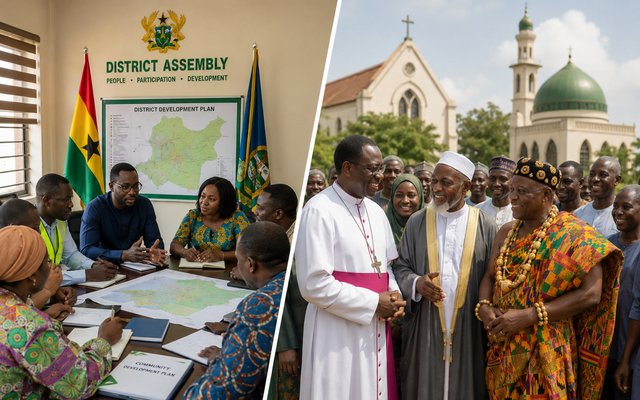
NATIONAL POLICY ON LOCAL GOVERNMENT, CHIEFTAINCY AND RELIGIOUS AFFAIRS FOR THE REPUBLIC OF GHANA
A World-Class Governance, Traditional Authority and Social Harmony Framework
Making Ghana Africa’s Model for Decentralised Development, Chieftaincy Stability and Religious Peace
“The Community Must Become the Centre of National Transformation”
1. Introduction
No nation can become truly developed when power is trapped only in the capital city. Development must not be a visitor from Accra. Development must live in the district, walk in the town, work in the village, speak with the chief, respect the assembly, protect the family, serve the farmer, empower the youth, include the woman, and honour the spiritual and cultural identity of the people.
Ghana’s future cannot be built by central government alone. The Republic must be rebuilt from the ground up through strong local government, respected traditional authority, peaceful religious institutions, responsible community leadership, accountable assemblies, empowered chiefs, active citizens, and development-focused decentralisation.
This policy proposes a new national governance architecture where local government becomes the engine of service delivery, chieftaincy becomes a mainstream pillar of development, and religious affairs become a force for peace, moral renewal and national unity.
The policy is built on one fundamental truth:
Ghana will not rise from the top alone. Ghana will rise when every community becomes a development centre.
The institution of chieftaincy remains one of Ghana’s most powerful and historically rooted systems of authority. Chiefs hold cultural legitimacy, community trust, historical memory, land authority, social influence and moral leadership. Yet for too long, the state has treated chiefs mainly as ceremonial figures, conflict managers or cultural symbols, instead of fully integrating them into the national development architecture.
This must change.
Under this policy, chiefs shall become mainstream agents of development. They shall be empowered to support local economic planning, land governance, education, sanitation, agriculture, cultural preservation, community mobilisation, tourism, environmental protection, dispute prevention and social cohesion.
However, empowerment must come with clarity, documentation, transparency and accountability. Therefore, every paramountcy shall be mandated to submit a verified Family Tree and Line of Succession Register to prevent chieftaincy conflicts, reduce litigation, protect tradition, preserve stool legitimacy and prevent the manipulation of succession by money, politics or violence.
This policy also recognises religious institutions as important moral and social actors. Churches, mosques, traditional religious institutions and faith-based organisations contribute to education, health, charity, peacebuilding and social discipline. The state must engage them respectfully while protecting religious freedom, national unity and constitutional order.
The mission is clear:
To build a Ghana where local government delivers, chiefs develop, religious institutions unite, communities prosper, and every district becomes a living engine of the New Ghana Agenda.
Vision
The vision of this policy is:
To transform Ghana into Africa’s leading model of decentralised governance, empowered chieftaincy, peaceful religious coexistence and community-led development; a nation where every district is productive, every paramountcy is organised, every chief is a development partner, every religious institution promotes peace, and every community participates directly in national transformation.
This vision seeks to build a Ghana where:
Local government is strong, efficient and accountable.
District assemblies deliver real development.
Chiefs are empowered as recognised development actors.
Every paramountcy has a verified succession record.
Chieftaincy conflicts are reduced through documentation, mediation and lawful dispute resolution.
Traditional councils are modernised and digitally supported.
Religious institutions promote peace, ethics, education and social harmony.
Districts are planned around local economic potential.
Traditional authorities participate in development without violating constitutional limits.
Communities are mobilised to build schools, markets, clinics, sanitation systems, tourism sites and local industries.
Local revenue is strengthened and transparently managed.
Ghana becomes the world’s example of how modern democracy and traditional authority can work together for development.
Mandatory Family Tree and Line of Succession Register
Purpose
Every paramountcy shall be required to submit a verified Family Tree and Line of Succession Register to the relevant traditional council, Regional House of Chiefs and National House of Chiefs.
The purpose is to:
Prevent chieftaincy conflicts.
Preserve customary legitimacy.
Protect rightful royal families.
Reduce succession manipulation.
Assist traditional councils and judicial committees.
Protect stool history.
Reduce violence and litigation.
Strengthen peace and investor confidence.
Protect future generations from confusion.
Contents of the Register
Each register shall include:
Recognised royal gates.
Family tree of each royal gate.
Historical succession list.
Customary rules of succession.
Eligibility criteria.
Role of kingmakers.
Role of queen mothers where applicable.
Stool history.
Relevant oral traditions.
Written customary records.
Dispute history.
Sacred restrictions where customary law permits disclosure.
Conflict resolution mechanisms.
Verification Process
The register shall be verified through:
Traditional councils.
Family heads.
Kingmakers.
Queen mothers.
Elders.
Customary historians.
Regional House of Chiefs.
National House of Chiefs.
Legal experts.
Independent cultural researchers where necessary.
Digital Preservation
A secure National Chieftaincy Succession Digital Archive shall be created.
The archive shall:
Store verified succession records.
Protect sensitive information.
Provide controlled access for lawful dispute resolution.
Preserve customary history.
Prevent document manipulation.
Support research and cultural preservation.
Reduce false claims.
Legal Effect
The register shall not destroy customary law. Instead, it shall preserve and clarify customary law.
Where disputes arise, the register shall serve as strong documentary evidence before lawful traditional and judicial processes.
Succession must not be left to confusion, money, political interference or violence.
Queen Mothers and Women in Traditional Development
Queen mothers and women traditional leaders must be fully integrated into development.
Policy Actions
Recognise queen mothers as development actors.
Include queen mothers in Paramountcy Development Councils.
Support girls’ education campaigns led by queen mothers.
Use queen mothers in maternal health advocacy.
Support women’s economic empowerment.
Support anti-violence and family welfare initiatives.
Preserve women’s traditional leadership roles.
Create Queen Mothers Development Forums.
A nation that ignores queen mothers ignores a powerful source of wisdom and social discipline.
District Economic Development Model
Every district shall be required to develop a District Economic Identity Plan.
Each district must answer:
What do we produce?
What can we process?
What can we export?
What tourism asset do we have?
What skills do our youth need?
What infrastructure will unlock our economy?
What investment can we attract?
Policy Actions
Create district industrial plans.
Develop district agriculture plans.
Promote district tourism.
Support local enterprise zones.
Develop market infrastructure.
Create youth skills centres.
Support district investment desks.
Link chiefs and assemblies in investment promotion.
No district must remain only an administrative boundary. Every district must become an economic unit.
Local Government and Chieftaincy Development Fund
A Local Government and Chieftaincy Development Fund shall be established.
Sources
National budget.
District revenue.
Private donations.
Diaspora contributions.
Development partner support.
Corporate social responsibility.
Cultural tourism revenue.
Stool land revenue contributions where lawful and agreed.
Purpose
Support community development projects.
Strengthen traditional council administration.
Support chieftaincy conflict prevention.
Fund cultural preservation.
Support local economic development.
Support religious peacebuilding initiatives.
Support district innovation and sanitation projects.
This fund must be transparently managed, independently audited and publicly reported.
Establishment of the National Chieftaincy and Culture College
A National Chieftaincy and Culture College shall be established as a world-class institution dedicated to the training, research, preservation, modernisation and development of Ghana’s chieftaincy, customary governance, traditional leadership and cultural heritage.
The College shall become the intellectual, administrative and cultural engine of Ghana’s traditional authority system. It shall not weaken customary law. It shall strengthen it. It shall not politicise chieftaincy. It shall protect it. It shall not replace elders, kingmakers, queen mothers or traditional councils. It shall equip them with the knowledge, documentation, administrative skills and development tools required for the future.
The purpose of the College shall be to ensure that chiefs, queen mothers, kingmakers, elders, stool secretaries, traditional council staff, cultural historians and youth leaders are properly trained to preserve tradition while leading development in a modern constitutional state.
Mandate of the College
The National Chieftaincy and Culture College shall:
Train chiefs, queen mothers, elders, kingmakers and traditional council officials.
Provide education in customary law, constitutional governance and traditional leadership.
Research and document Ghana’s traditional histories, royal lineages, succession systems and cultural practices.
Support the preparation and verification of Family Tree and Line of Succession Registers.
Train traditional leaders in conflict prevention and dispute resolution.
Support the modernisation of traditional councils.
Train chiefs in local economic development, land administration and community planning.
Preserve Ghanaian languages, festivals, sacred traditions, oral histories and cultural heritage.
Promote ethical traditional leadership.
Support youth education in culture, identity and national belonging.
Serve as a centre for chieftaincy research, culture, governance and peacebuilding.
Position Ghana as a global centre for the study of African traditional governance.
Academic and Training Departments
The College shall include departments such as:
Department of Customary Law and Succession Studies.
Department of Chieftaincy Governance and Traditional Leadership.
Department of Culture, Heritage and Oral History.
Department of Conflict Resolution and Peacebuilding.
Department of Land, Stool Property and Natural Resource Governance.
Department of Queen Mothers and Women in Traditional Leadership.
Department of Local Development and Community Transformation.
Department of Religious Harmony and Social Cohesion.
Department of Traditional Diplomacy and Protocol.
Department of African Languages, Festivals and Cultural Tourism.
Department of Digital Archives and Cultural Documentation.
Department of Ethics, Accountability and Public Leadership.
Training Programmes
The College shall offer:
Certificate in Traditional Leadership.
Diploma in Chieftaincy Governance.
Advanced Certificate in Customary Law and Succession.
Certificate in Stool and Skin Administration.
Certificate in Queen Mother Leadership and Community Development.
Diploma in Culture, Heritage and Tourism Development.
Certificate in Chieftaincy Conflict Mediation.
Certificate in Traditional Council Administration.
Certificate in Land and Stool Property Governance.
Executive Leadership Programme for Paramount Chiefs.
Young Royals Leadership Programme.
Training for kingmakers, elders and family heads.
Training for traditional council registrars and staff.
National Chieftaincy Research and Documentation Centre
The College shall host a National Chieftaincy Research and Documentation Centre.
This Centre shall:
Collect oral histories.
Preserve royal genealogies.
Document customary practices.
Support succession verification.
Digitise traditional records.
Protect cultural archives.
Research festivals and traditional governance systems.
Support traditional councils with historical evidence.
Publish academic and policy research on chieftaincy.
This Centre shall work closely with the National House of Chiefs, Regional Houses of Chiefs, traditional councils, universities, historians, anthropologists, linguists, archivists and community elders.
Chieftaincy Succession Support Unit
A specialised Chieftaincy Succession Support Unit shall be created within the College.
The Unit shall:
Assist paramountcies to prepare family trees.
Support documentation of royal gates.
Provide technical support for succession registers.
Train family heads and kingmakers.
Help preserve customary succession rules.
Provide non-partisan research support during disputes.
Support mediation with historical and customary evidence.
The Unit shall not decide who becomes chief. That power remains with lawful customary and statutory processes. Its role shall be to support clarity, documentation, preservation and peace.
Culture, Identity and Youth Education
The College shall also serve as a national centre for teaching young Ghanaians about culture, identity and responsible citizenship.
It shall develop programmes for:
School cultural clubs.
Youth heritage camps.
Language preservation.
Traditional music and dance documentation.
Cultural tourism training.
Youth leadership under traditional authority.
Diaspora cultural education.
National identity and civic pride.
Ghanaian children must not grow up disconnected from the traditions that shaped the nation.
Governance of the College
The College shall be governed by a Board composed of:
Representatives of the National House of Chiefs.
Representatives of Regional Houses of Chiefs.
Queen mothers.
Ministry responsible for Chieftaincy and Culture.
Ministry responsible for Local Government.
Universities and research institutions.
Customary law experts.
Cultural historians.
Religious harmony representatives.
Youth and women representatives.
Legal and constitutional experts.
The College shall operate with academic independence, cultural sensitivity, non-partisanship and accountability.
Regional Campuses
The National Chieftaincy and Culture College shall establish regional campuses or study centres to reflect Ghana’s cultural diversity.
These regional centres shall specialise in the traditions, languages, histories, succession systems, festivals and cultural assets of their areas.
The College must not centralise culture in Accra alone. Culture lives in the regions, towns, villages, stools, skins, gates, clans and families.
Expected Impact
The establishment of the National Chieftaincy and Culture College shall:
Professionalise traditional leadership.
Reduce chieftaincy conflicts.
Preserve Ghana’s cultural heritage.
Strengthen succession documentation.
Improve traditional council administration.
Empower queen mothers.
Train chiefs as development leaders.
Protect royal histories from distortion.
Strengthen local peacebuilding.
Promote cultural tourism.
Deepen national identity.
Make Ghana a global centre for African traditional governance studies.
Policy Declaration
The establishment of the National Chieftaincy and Culture College shall represent a historic national commitment to the dignity of tradition, the stability of stools and skins, the empowerment of chiefs, the preservation of culture, and the development of communities.
A New Ghana must not abandon its roots in the name of modernity.
A New Ghana must modernise its roots so they can carry the future.
Ghana’s next transformation must begin at the local level. The Republic must stop treating communities as receivers of development and start treating them as engines of development.
Chiefs must no longer be seen only during festivals, funerals and ceremonies. They must become development commanders in their traditional areas, working with assemblies, citizens, investors, religious leaders, youth and women to build schools, markets, clinics, roads, tourism sites, sanitation systems, local industries and peaceful communities.
But chieftaincy authority must also be protected from conflict. That is why the mandatory Family Tree and Line of Succession Register is a historic necessity. It will preserve tradition, prevent manipulation, reduce violence, protect rightful royal families and secure the future of stools and skins.
Religious institutions must also become partners in moral renewal, peacebuilding, education, welfare and national unity. Ghana’s religious diversity must remain a blessing, not a battlefield.
This policy calls for a governance revolution.
A revolution of local government.
A revolution of chieftaincy development.
A revolution of succession clarity.
A revolution of religious harmony.
A revolution of district economic planning.
A revolution of community participation.
A revolution of cultural dignity.
A revolution of peace.
The mission is clear:
Ghana must build from the community upward.
When the chief is empowered, the community rises.
When the assembly works, the district develops.
When religious leaders unite, the nation becomes peaceful.
When succession is clear, conflict reduces.
When culture is protected, identity is strengthened.
When local government is accountable, democracy becomes real.
A New Ghana must not only be governed from the capital.
A New Ghana must be built from every stool, every district, every community and every home.