National Security & Intelligence.
Safe homes, safe borders, trusted uniforms.
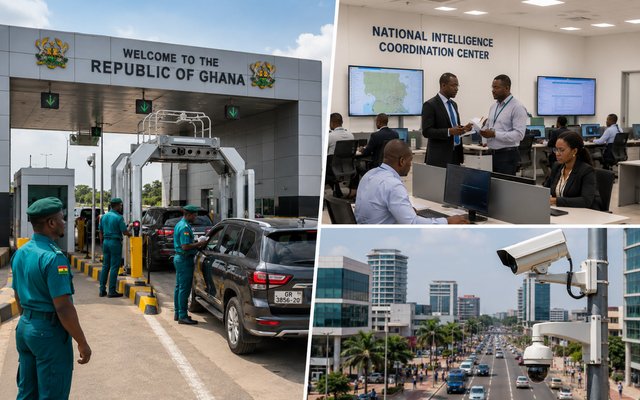
COMPREHENSIVE NATIONAL SECURITY, INTELLIGENCE AND CITIZEN PROTECTION POLICY FOR THE REPUBLIC OF GHANA
A Futuristic Security Architecture for a Safe, Intelligent and Resilient New Ghana
Introducing the National and Regional Security Banks
“Ghana Must Provide Proper Security for the Ghanaian”
1. Introduction
Security is the first responsibility of every serious state. Without security, there can be no peace. Without peace, there can be no development. Without development, there can be no dignity. A nation may have roads, hospitals, schools, factories, natural resources, technology and investment, but if its citizens are not safe, if its borders are weak, if its data is exposed, if crime is organised, if intelligence is fragmented, and if public trust in security institutions is broken, the future of that nation becomes uncertain.
For Ghana, national security must be redefined. Security must no longer be seen only as the protection of government, political authority, state institutions and high-profile personalities. Security must become the protection of the Ghanaian citizen, the Ghanaian home, the Ghanaian child, the Ghanaian farmer, the Ghanaian worker, the Ghanaian student, the Ghanaian business, the Ghanaian border, the Ghanaian economy, the Ghanaian democracy and the Ghanaian future.
The central philosophy of this policy is clear:
Security is not the protection of power; security is the protection of the people.
Ghana has long been respected as a peaceful and stable democracy in West Africa. However, the security threats of the modern world are changing rapidly. The country must prepare for terrorism threats in the sub-region, violent extremism, cybercrime, organised crime, illegal mining networks, maritime insecurity, drug trafficking, human trafficking, border infiltration, election-related violence, digital disinformation, financial crime, resource theft, communal conflict, land disputes, youth unemployment, climate insecurity, food insecurity, energy insecurity and threats against critical national infrastructure.
The future of security is no longer only about guns, uniforms, barriers and patrols. The future of security is about intelligence, technology, data, community trust, cyber resilience, economic protection, emergency preparedness, lawful surveillance, professional discipline, social stability and democratic accountability.
This policy therefore proposes a complete national security and intelligence transformation for Ghana. It introduces an integrated system where intelligence, policing, defence, cybersecurity, border control, emergency response, economic security, community protection and institutional coordination work together under one national vision.
At the heart of this policy is the introduction of Security Banks — secure national, regional and strategic district centres for intelligence fusion, lawful data protection, national data protection center, emergency resources, threat analysis, crime mapping, disaster preparedness, border monitoring, cyber incident reporting and public safety coordination.
Security Banks shall not be political spying centres. They shall not be tools for intimidation. They shall not operate outside the Constitution. They shall be lawful, professionally managed, audited and rights-protected national security infrastructure designed to help Ghana prevent threats before they become crises.
The mission is historic:
To make Ghana the safest, smartest, most trusted and most advanced security and intelligence hub in Africa.