Transport.
Rail, roads, and a nation that moves.
COMPREHENSIVE NATIONAL TRANSPORT POLICY FOR THE REPUBLIC OF GHANA
A Futuristic, Integrated and Globally Competitive Transport Framework
Positioning Ghana as Africa’s Premier Transport, Logistics and Mobility Hub
1. Introduction
Transport is not merely about movement. It is the bloodstream of a nation’s economy, the foundation of trade, the bridge between production and markets, the connector of communities, the engine of tourism, the driver of industrialisation, and the physical expression of national development.
No country can become economically powerful without a transport system that is reliable, safe, affordable, modern, inclusive, technology-driven and globally connected. Ghana’s ambition to become a leading African economy requires a transport system that can move people, goods, services, ideas and investment with speed, dignity and efficiency.
Ghana occupies a strategic position on the Gulf of Guinea, with access to the Atlantic Ocean and land connections to Burkina Faso, Mali, Niger, Côte d’Ivoire and Togo. This geography gives Ghana the potential to become the most important transport and logistics gateway between coastal West Africa and the Sahel. Ghana’s ports, airports, roads, railways, inland waterways, border corridors and digital transport systems must therefore be developed as one integrated national platform.
Ghana’s current transport sector has made important progress, including improvements in port infrastructure, airport services, roads and national transport planning.
The Ministry of Transport’s 2025 budget framework identifies policy objectives such as improving airport and seaport infrastructure, creating a sustainable and integrated transport system, enhancing road safety and promoting public-private partnerships. Ghana has also revised its National Transport Policy and developed a National Electric Vehicle Policy, showing a national shift toward modern mobility.
However, Ghana must now move beyond gradual improvements. The future requires a bold transport revolution. Ghana must build a transport system that is multimodal, digital, climate-smart, safe, inclusive, industrially connected and regionally integrated. Roads must connect seamlessly to railways.
Railways must connect to ports. Ports must connect to inland dry ports. Airports must connect to cities, tourism zones and logistics centres. Public transport must become organised, dignified and technology-enabled. Freight must move efficiently. Border delays must reduce drastically. Transport data must guide decision-making. Electric mobility must be planned. Road safety must become a national discipline.
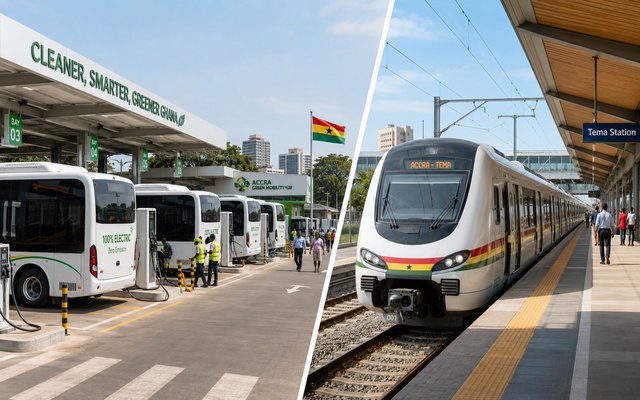
This policy proposes a future-ready transport architecture for Ghana; one that integrates road, rail, aviation, maritime, inland water transport, logistics, public transport, non-motorised transport, electric mobility, digital transport, rural mobility, safety, financing and regional trade corridors into one national development strategy.
The central philosophy of this policy is simple:
Ghana must not only transport people and goods; Ghana must transport the nation into the future.